Managing the Octopus

Team Contract

For the Project Based Learning Teacher Certification course I am undertaking with PBLU, I recently had to submit an assignment outlining and reflecting upon the management of the project. This report focuses on on the formation and organisation of teams; use of strategies for conflict resolution and decision-making and the different tools that can be used to support the teams.

TEAM GROUPINGS
Teams were formed through close consultation with both the Learning Support (LS) and English Language Support (ELS) departments. After much discussion and deliberation about possible groupings, it was decided that the best option was to divide those with specific learning needs equally out amongst teams and to provide stronger learners in each team. LS and ELS teachers have also been in supporting learners in this challenging process and we meet regularly to discuss the progress. ELS support the language learners with extra lessons after school synchronously with the skills being covered in class and it has been noted that learners have benefited from being in groups with native English speakers. Equally, the LS department are really pleased with the progress of the learners under their care; they feel that the responsibility given to the learners to take control of the learning has has a huge impact on their confidence and we see learners standing and giving presentations in front of the class who were once very reluctant and shy to do so. One of the biggest changes has been in the support mechanisms developed - learners were not a unit, they did not operate together and were uncommunicative, lacked self-regulation and were often just plain mean to each other. That has changed completely - they are kind, supportive, critical friends who are working harmoniously with a shared goal.

In Phase 3, the final design part of the project, learners were asked to reflect in detail about the research and presentations of Phase 2. They were then given the opportunity to rethink the teams and processes learned in Phase 2, and suggestions were taken onboard in the formation of these final teams. This meant that learners were assigned teams but also given the opportunity to decide on their own teams too - which gives weight to their responsibility and ‘buy in’. The journey they have come on now means they are in a position to make wise decisions about the various strengths of all the different learners in the classes to form great, cooperative teams.


TEAMWORK

As we are an all-inclusive school, we have a variety of learners with varying needs from behavioural and learning to language and social, as outlined above. Therefore, a great deal of the first Phase of the project was spent on deciding what a good team player was and the behaviours they should demonstrate.

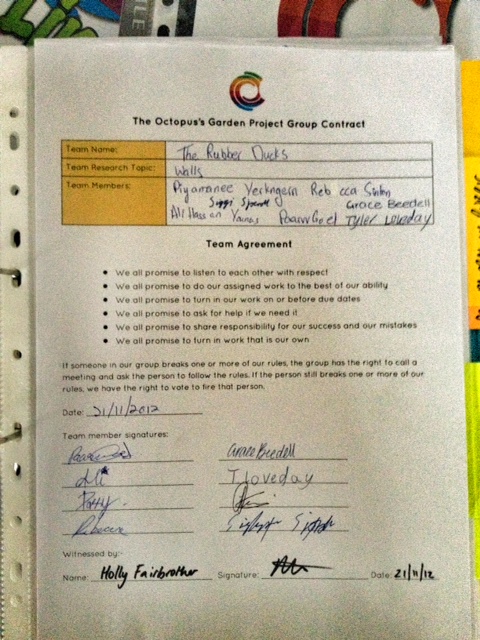
Learners split into groups and, using the bie.org rubric as a starting point, researched and developed this so it was co-constructed to meet their needs. We spent a lot of time (Phase 1) discussing how to deal with issues such as non-compliance and non-contribution and learners used the IB Learner Profile to identify characteristics that we all understood and recognised as necessary for successful collaboration. We also designed and signed a contract for teamwork, which learners in ‘trouble’ were referred to; many issues were resolved using this and the co-constructed rubric. By making the behaviour of teamwork measurable, learners felt a responsibility and ownership of the project, that has meant there has been little conflict or need for many resolutions. I think spending a good amount of time building a strong foundation of understanding and expectations really helped and even though it took some time, it was truly beneficial in the long run.

In addition, I think that having clearly defined roles within the teams also helped, as everyone had a job description and this transparency allowed all team members to know what their responsibilities were as well be able to guide others who were falling behind on their contributions. Giving them power and responsibility allowed them to be mature and critical teamplayers.

MANAGEMENT LOG

We have used a variety of methods and tools to manage the variety of different tasks, as learners did not always like the idea of a ‘list’. 
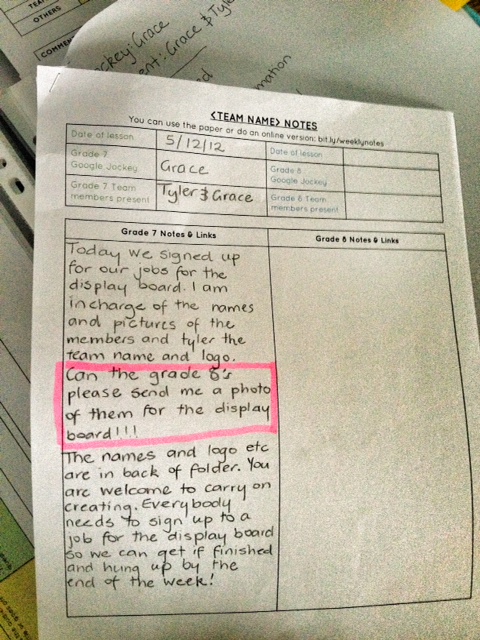
Daily Notes

Management Log: For Phase 3 of the project, learners have decided to complete a management log to try to help them be more organised and because they like to explore every possible avenue.

Other tools we have used are:

Calendar: we have a Google Calendar embedded into our website which outlines the main parts of the project; this is negotiable and discussed and amended regularly.

Files: each team has a file; the file has rubrics, contracts and job descriptions as well as a section for each round - which is roughly 1-2 weeks. Each round has a log to show who is responsible for what, a section for leaving notes to communicate between each grade/class and assessment sheets for peer assessment for each round; learners really like their files and have filled them with notes and ideas and refer to them each lesson. 
Team Files

Edmodo: deadlines, quizzes and assignments are all put onto Edmodo; all communication happens here so all are responsible in helping reach deadlines or solve problems

Agenda: we have an agenda for each lesson; I create it based on issues raised from last lesson noted in the files, on Edmodo or from learner feedback, along with the schedule of tasks currently scheduled in the calendar or that have been identified in the Need to Know list; this is shared and discussed at the start of each lesson. Learners are able to add additional items to the agenda as needed. This is also embedded on the website and put onto Edmodo for those learners who may be absent, so that learners have access to it at all times.

Workshops: we have workshops based on the Need to Know list and as identified as we work; some skills have come up through lessons and workshops have been developed accordingly. These include note making, persuasive writing, film making, recount writing and report writing.

Blog & Twitter: The Octopus Garden Blog keeps our community informed about developments, as does our Twitter @NISSOctopus; equally, learners all have personal blogs where their reflections are posted Grade 7, Grade 8

The combination of all these tools means that learners are in constant communication and are always up to date as they have become part of our habits of mind. It has taken a bit of practice to train all learners up in keeping up to date as we only went officially 1:1 in the middle of the project. However, as a result of this and the sudden increase in e-tools and communication from all lessons, we discussed and came up with the concept of ‘Tech Time’; this is five minutes given at the start of the lesson, where learners are given time to catch up with emails and Edmodo and ensure they try to keep a zero inbox.

Empowering learners to have a say and to take responsibility has been really useful in ensuring they are up to date and learning to manage their communication and collaboration tools. Adopting a variety of different tools has allowed me to stay of top of this huge project and allow me to be in constant contact with learners and our communication has become shared, reflective and effective.

Comments

Past Thoughts

CONNECTION

We had our kick-off meeting last week on Tuesday 5 February 2013. I was able to connect using Blackboard Collaborate , something I had not used before, but unfortunately had to leave as I was at school. However, with it being Chinese New Year I have had an extended weekend, so was able to catch up and watch the full recorded version. I have also had a cold so have not felt up to tackling the mountain of marking, but have caught up on my reading for the next meeting, namely Chapters 1-3 of the book, ' Flattening Classrooms, Engaging Minds '; my Tweets about the most interesting salient points for me personally, can be found under @MrsHollyEnglish under #flatclass. Having reached the end of Chapter 3, I have come across my first 3 of the 15 Flat Classroom Challenges. Having taken part in the survey assessing my current connectivity, I feel confident that I am currently in a good position - I already have established a sound PLN that I build on when I can and have added s...

Creativity Runs Wild

“There’s probably no better example of the throttling of creativity than the difference between what we observe in a kindergarten classroom and what we observe in a high school classroom.” (Levine) Wherever in the world I have been teaching, one of the most common observations of my classroom by other teachers is that it is "like a primary classroom". This is, more often that not, said in a derogatory and dismissive way, as if the colourful and expressive landscape of learning created through explorations of language and literature is a negative thing. That I cannot possibly be teaching a secondary curriculum if they seem to be creating so much..."mess" (as it has also been called). I have never paid much attention to this; I believe that my IB Diploma English Literature class learnt a great deal about the symbols, motifs, characters, language, themes and setting through the mural we painted all over the classroom. They learnt to problem solve and collaborate...

What Are We Learning?

Reflections on the First Week of Classroom Observations This year, classroom visits are framed by a Looking for Learning approach. The premise is simple: rather than focusing on what the teacher is doing, a small set of questions is used to gain a deeper understanding of the students' learning experience. Over the course of the year, the lens is through these four guiding questions: What are you learning today? Why do you think you are learning this, and how does it connect to what you have done before? How is your thinking shifting? How will you know you have been successful in your learning? These questions are deceptively simple, but they open windows into clarity, purpose, metacognition , and self-assessment. For this first phase, however, I deliberately chose to begin with just one: What are you learning today? At the start of a new academic year, it did not feel appropriate to press students yet about how their thinking was shifting or how they would evalua...

From Binary to Both/And: Deepening Clarity and Feedback in Classrooms

This week marked my second cycle of Looking for Learning visits. One of the greatest joys of this process has been the conversations that follow. Teachers have welcomed me into their classrooms with openness and trust, and our discussions afterwards have been equally generous and insightful. This culture of dialogue, where wonderings are met with reflection and opportunity, is a bright spot in itself. It reflects our shared belief that we are already strong educators and  that we can continue to grow together.  Across classrooms, several patterns of strength emerged: Clarity of learning: Many students were able to explain what they were learning and how it built on what had come before. They were not only describing the task but also connecting it to prior knowledge, showing they were constructing new understanding. Intentional design for collaboration and concept formation: I saw varied and purposeful groupings, where students were supporting one another’s learning....

Habits of Learning

Habits of Learning:  Responsible, Reliable Management of  Online Activity For Module 3: Citizenship, of the Flat Classroom Teacher Course, we have been assigned 'Quadblog' groups; this gives us a taste of what it is like to try to work asynchronously towards a common goal with people we don't know and who are in different time zones. My group has been assigned the topic of Individual Awareness ,  which is one of the areas of awareness that permeate every area of digital citizenship. Within each of the five areas of awareness - technical, individual, social, cultural and global - there are four "rays of understanding": Safety, Privacy, Copyright, Fair Use, and Legal Compliance; Etiquette and Respect; Habits of Learning: Responsible, Reliable Management of Online Activity, and Literacy and Fluency. For the Quadblog group, I am tackling the understanding of Habits of Learning: Responsible, Reliable Management of Online Activity within the concept of individu...

Collaboration: The Legacy

Dipping my toes... For the first three months of 2013, I took part in my first MOOC, 'Designing a New Learning Environment' offered by Stanford University via an initiative called Venture Lab . I signed up because it ties in with my Octopus's Garden Project and also because I wanted to experience this Flat Classroom-global-type of learning for myself. The course required us to watch weekly lectures and complete readings; for assessment we had to submit five individual assignments, one final team assignment and five peer assessments of other final projects. We signed up for teams of our choice and developed an area within new learning environments; developing our final project design based on our findings, readings and experience. Leading & Contributing I became team leader late on in the project as the original one, the one who set up the actual topic, went quiet and dropped off the radar. Having 40000 people taking part in a course makes it hard to communicate wi...

It's all about Choice and Voice

Collaborative Planning in PBL In Phase 3 of The Octopus's Garden Project, Grade 7 and Grade 8 have been working on the importance of visuals in getting their message across clearly and effectively to their audience. They recently collaborated to decide how to proceed with their final design presentations. Using the feedback and reflections from their Phase 2 presentations, along with some lesson on slide design and visual story-telling, they created a list of  guidelines  to guide their final designs.    Introduction to Slide Design: 7 Rules for Creating Effective Slides from Alex Rister Lots of critical thinking happened as learners made important decisions about how teams would be formed, how the presentation would work, what would be included and the order each section would occur in. Learners took part in a poll to decide on team formation for this Phase and then, using the guidelines and learning from the slides above, worked on planning out...

Building Feedback Literacy: Quantitative Insights into Feedback, Rubrics, and Formative Assessment

Feedback has long been recognised as one of the most significant factors influencing student achievement. Quantitative evidence, particularly from large-scale meta-analyses, consistently demonstrates that feedback interventions produce some of the highest effect sizes of any educational practice (Hattie & Timperley, 2007; Wisniewski, Zierer, & Hattie, 2020). Yet, these same studies reveal a wide variation in outcomes, with some forms of feedback accelerating learning substantially, while others appear ineffective, or even detrimental. This paradox highlights a crucial challenge for educators: the mere presence of feedback is insufficient. Its impact depends on how clearly it communicates goals, how effectively it guides students’ next steps, and whether learners possess the capacity to interpret and apply it. This capacity is increasingly described as feedback literacy; the skills and dispositions students require to make sense of, use, and seek feedback to improve their learni...

The Octopus's Garden - Inspired Creativity

I was amazed today at how much a simple rearrangement of the learning has rearranged the thinking space. Immediately today, my Grade 8s utilised all the different possibilites - the make-shift Chrome Books (though we have some issues there regarding speed and applications), the Macs, the floor, the paper and paint and crayons - they were painting, sculpting with paper, making collages, Prezis and Pixton cartoons; they shared work and gave feedback and collaborated more than they ever had - it was awesome and made me even more exciting to roll out the project. Look what has happened with a shift of furniture. Imagine the possibilities when we rethink and customise the whole space... :)

Teacher Geeks: Technology Professionals

In the latest module of my Masters in Education and Instructional Technology, we studied "Administration of Technology Initiatives: Planning, Budgeting, and Evaluation". This involved us exploring how to research and write for grants, as well as design and plan at both classroom and school initiative level. As many schools are implementing technology into their curriculum, it is important that we think about the role that educators and technology integrators can play in successful technology use in the classroom. This following is my research into technology professionals conducted during the summer of 2016. I have since gained employment elsewhere and am no longer working at the school mentioned in this paper. ------------------------------------------------------------------------------------------------------------- --> Technology Professionals: The ‘Interview’ With the advent of technology becoming more prevalent in schools, many establishments...